


In the world of Singapore Real Estate Investment Trusts (S-REITs), the narrative has long been dominated by institutional “smart money.” However, a closer look at retail capital flows between 2024 and 2025 reveals a profound shift in mindset.
What retail investors are refusing to buy today tells a far more compelling story than what they are actually holding.
From “Buying Cheap” to “Buying Safe”
The data points to a retail investor base that has clearly matured after several years of volatility. Published market figures show a clear divergence between retail and institutional behaviour across the top 10 S-REITs.
The Great Divide: 2024 vs. 2025
| Metric | 2024 (Buying the Dip) | 2025 (Flight to Quality) |
|---|---|---|
| Retail Net Inflow | ~S$1.6 Billion | ~S$1.0 Billion |
| Institutional Net Outflow | ~S$1.6 Billion | ~S$1.3 Billion |
| Market Condition | Falling prices / Negative returns | Rebounding / Recovering |
| Retail Strategy | “Buy Cheap” | “Buy Safe” |
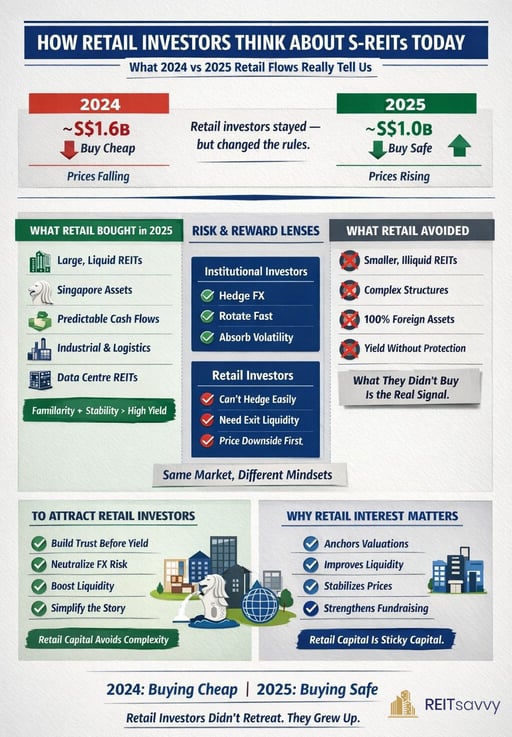
In 2024, retail investors injected approximately S$1.6 billion into S-REITs, attempting to catch a falling knife as higher interest rates compressed valuations. By 2025, even as prices began to recover, retail investors remained net buyers—albeit more selectively—with inflows of roughly S$1.0 billion.
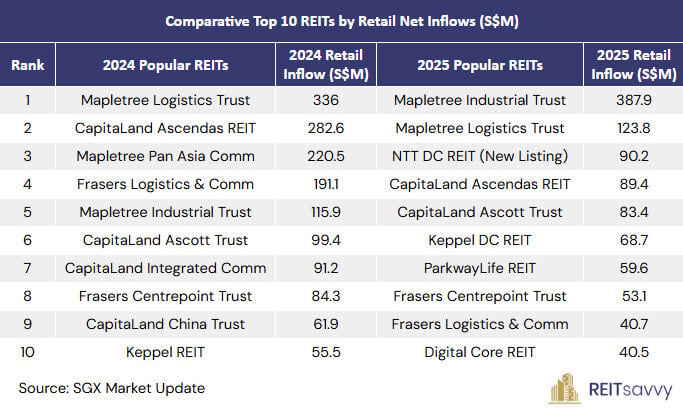
Crucially, while institutional investors were net sellers in both years, retail capital stayed invested—but rewrote the rules of engagement.
The Filter: Familiarity, Liquidity, and Resilience
At first glance, the REITs attracting the strongest retail inflows appear unsurprising: large-cap, government-linked, and highly familiar names. The true signal, however, lies in what is absent from retail portfolios.
What Retail Investors Are Avoiding
-
Pure Foreign-Asset REITs
Years of FX volatility, overseas asset write-downs, and distribution cuts have visibly dampened appetite for fully foreign portfolios. -
Illiquid Small-Cap REITs
REITs with market capitalisations below S$1 billion—even those offering high headline yields—are increasingly bypassed. Liquidity and exit optionality now outweigh marginal yield enhancement. -
Complex Financial Engineering
Over-leveraged or “cleverly structured” REITs are being met with growing scepticism rather than enthusiasm.
The “Data Centre” Exception
Data Centre REITs remain the notable outlier. Despite their technical complexity, they benefit from a powerful structural narrative—AI adoption, cloud computing, and digitalisation—that retail investors can easily understand and trust.
The Liquidity Problem: A Symptom of Outdated Investor Relations
Persistently low trading liquidity among smaller REITs is often a symptom of outdated Investor Relations (IR) strategies. Many sub-scale REITs remain invisible to institutions due to size constraints, yet management teams continue to focus almost exclusively on Non-Deal Roadshows (NDRs) targeting institutional investors.
Liquidity cannot improve if retail investors are neglected. Expecting different outcomes while maintaining the same exclusionary engagement habits is unrealistic. The data is clear: retail investors are now the marginal liquidity providers.
The Long Game of Retail Engagement
Retail engagement requires significantly more effort and consistency than institutional pitching. Results are rarely immediate. However, experience shows that a clear communications roadmap—combined with persistence and conviction—pays dividends.
Engaged retail investors often evolve into long-term brand advocates, amplifying a REIT’s message organically through word-of-mouth. This grassroots support system is something institutional capital simply cannot replicate.
Why the Retail Mindset Shifted
Unlike institutional desks, retail investors lack easy access to currency hedging tools and cannot rotate out of multi-million-dollar positions in a single trading session. Hard-earned experience has taught them that:
-
Refinancing stress is real and immediate
-
Rights issues can be deeply dilutive if unprepared
-
Distribution cuts inflict more damage than short-term price volatility
As a result, retail investors are now filtering decisively for stability over yield. A dependable 5% distribution yield from a Singapore-based industrial heavyweight is preferred over a volatile 8% yield from a foreign office portfolio.
The Wake-Up Call for REIT Managers
For REIT managers who have historically prioritised institutional flows, this shift should serve as a wake-up call. Retail capital is not “dumb money.” It is sticky capital—providing liquidity depth and valuation anchors during periods of market stress.
The New Retail Manifesto
To attract today’s retail investor, REIT managers must:
-
Neutralise FX Risk
Address currency exposure transparently rather than glossing over it. -
Prioritise Liquidity
Improve free float and maintain consistent market engagement. -
Simplify the Story
Avoid unnecessary financial complexity. -
Build Trust
Communicate risks honestly and proactively, not defensively.
About the Authors
Kenny Loh
Founder of REITsavvy, Kenny is a recognised S-REIT specialist and an SGX Academy trainer. He is a frequent guest on MoneyFM 89.3 and Channel NewsAsia, and a regular speaker at the REITs Symposium. As both a specialist and a retail investor, he provides advisory services focused on individual investor needs.
Cecilia Tan
Former CEO of Sasseur REIT, Cecilia brings an insider’s perspective on the challenges facing REIT managers. With direct experience managing both institutional and retail expectations, she offers strategic insights into navigating the evolving REIT landscape.