


Should S-REIT managers tell investors more about what lies ahead?
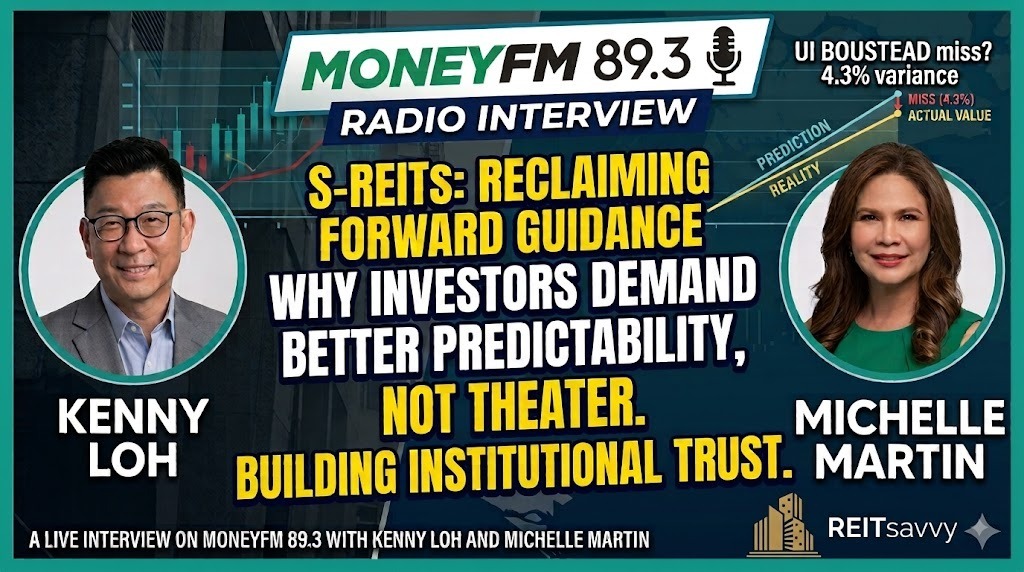
Michelle Martin speaks with Kenny Loh, REIT Specialist and Wealth Advisory Director, about the push for stronger forward guidance from Singapore REITs and whether greater transparency could lead to better investment decisions.
What would constitute meaningful guidance?
What are investors currently hearing from investor-relations teams?
Could more guidance improve management accountability, or encourage short-term decision-making simply to hit a number?
And should REITs that communicate more transparently ultimately command higher valuations?
Click to listen to Podcast
Question 1: What separates genuinely useful forward guidance from investor-relations theatre?
Michelle, IR theatre is about generating headline hype; genuinely useful guidance is about providing operational visibility.
Let me give you an analogy.
Suppose I tell you, 'Michelle, I plan to exercise and lose weight this year.' That sounds nice, but it’s completely unmeasurable.
Compare that to me saying: 'I am going to lose 4 kg in one month by exercising one hour every day, rain or shine, and cutting down to two meals a day. If I miss a workout on Tuesday, I will make up for it on Wednesday, and I will track my weight every Friday.'
Which statement shows real commitment and operational accountability? And which one gives me room to manufacture excuses when I don't hit the target a month later?
That’s the difference in capital markets:
-
IR Theatre relies on vague statements—saying things like 'we remain cautiously optimistic' or 'we expect headwinds'—without quantifying anything or holding management accountable.
-
Useful Guidance provides specific, measurable parameters—like NPI, DPU, interest cost, etc.
-
Most importantly, it stops the practice of selective explanation—where management enthusiastically details good news, but grows opaque or blames the macro environment when results fall short. Useful guidance creates an objective benchmark that holds management accountable in all conditions."
Question 2: UI Boustead REIT’s NPI missed its IPO forecast by 4.3%. How can investors tell the difference between a meaningful miss, or a headline that diverts from actual strong fundamentals?
Investors need to look past the headline variance and ask one fundamental question: Is this an execution failure or an operational model variance?
In UI Boustead REIT’s maiden results, the headline reported an NPI shortfall of 4.3%. But when you look under the hood:
-
Committed occupancy surged to 98.1%.
-
Japan assets hit 100% committed occupancy.
-
Singapore rental reversions were positive at +2.6%.
-
Property operating expenses came in below budget.
-
Joint venture income outperformed forecast by over 30%.
The NPI slippage was almost entirely driven by two factors: a weakening Japanese Yen and minor execution friction around lease commencement timing.
A meaningful miss happens when core operational metrics fail—like falling occupancy, negative rental reversions, or structural tenant defaults.
A transient headline variance happens when underlying real estate metrics improve, but short-term FX translation or lease timing creates temporary noise. Investors must learn to judge whether a forecast was simply flawed, or if the underlying asset degraded."
Question 3: Can REITs provide clearer guidance than other companies?
Absolutely. In fact, REITs have less excuse than almost any other sector listed on the SGX.
Consider ordinary corporate stocks—a consumer tech firm or retailer faces violent swings in demand, supply chain shocks, product obsolescence, and seasonal cycles.
-
A REIT's financial architecture is structurally engineered for predictability:
-
Contractual Revenue: Income is backed by multi-year leases with fixed rental steps.
-
Hedged Costs: Interest costs are largely locked in via fixed-rate hedges, and property debt maturities are known years in advance.
-
Static Asset Footprint: Operating expenses and property maintenance costs are highly predictable.
With fixed top-line visibility and hedged cost structures, REIT managers are sitting on the most predictable models in public capital markets. Withholding forward guidance under the guise of 'market uncertainty' directly contradicts the fundamental nature of the asset class.
Question 4: Which forward indicators matter most?
Instead of just asking for a single headline Distribution Per Unit (DPU) forecast, investors should focus on four leading operational metrics:
-
Weighted Average Lease Expiry (WALE) & Expiry Profiles: What percentage of gross rental income is coming up for renewal over the next 12–18 months, and what are current market spot rents relative to passing rents?
-
Rental Reversion Guidance: Is management projecting flat, single-digit, or double-digit reversions across specific sub-sectors (e.g., logistics vs. commercial office)?
-
Capital Management Metrics: Fixed-rate debt ratios, average cost of debt, and upcoming refinancing cliffs. If 30% of debt matures next year at a higher rate, what is the exact distribution impact?
-
Occupancy Commitments: Looking at committed vs. actual physical occupancy to spot lease turnarounds before they hit cash flow.
Question 5: Do you think currently investors put more weight on a REIT hitting its forecast or management explanation for any gaps between forecast and results?
Right now, the market is overly fixated on the binary 'hit or miss'. That’s partly because retail investors and algorithms react to headline news algorithms.
However, institutional capital acts differently. Institutional investors understand that the future cannot be predicted with 100% precision. What builds long-term institutional trust is credibility in management explanation.
If a REIT hits its forecast purely because of a one-off tax write-back or an unexpected non-operational gain, that’s poor quality execution masking a bad operational quarter. But if a REIT misses a target due to an exogenous currency shift—yet management transparently details why it changed, whether it’s temporary or structural, and how they are hedging it—investors will reward that management team with trust.
Markets don't ultimately invest in crystal balls; they invest in the credibility of the people managing the business.
Question 6: What would forward guidance do for investors — improve accountability or encourage short-term decisions simply to hit a number?
Michelle, it dramatically improves accountability and market efficiency if guidance is structured properly.
The idea that management will make short-sighted cuts just to hit a single quarterly number only happens when guidance is treated as a rigid, single-point target. That’s why REIT managers should provide a DPU guidance range—a low, base, and high scenario.
Providing a clear range solves a major irony in our capital markets today.
Right now, when REITs withhold guidance, equity analysts are forced to play a guessing game—plugging blind assumptions into their financial spreadsheets. IR teams have actually shared with me that they spend countless hours reading published analyst reports just to spot and correct flawed assumptions after the fact!
Isn't that completely backwards? Why spend time checking other people's homework when the REIT manager can provide a realistic guidance range from the outset?
A guidance range eliminates the guessing game, aligns analyst expectations with reality, and shifts IR from reactive damage control to proactive transparency.
More importantly, public guidance drives real internal discipline:
-
Internal Alignment: It forces executive teams to translate financial targets into actionable KPIs for asset management and leasing teams.
-
Mandatory Stress-Testing: Leadership is compelled to stress-test FX shifts, interest rates, and leasing lag before they manifest on balance sheets.
-
Proactive Risk Management: It forces managers to act early—renegotiating leases or tightening hedges—rather than manufacturing retrospective excuses at year-end.
Question 7: Should transparent REITs command higher valuations?
Yes, absolutely—and economic theory as well as human psychology prove it.
Michelle, it comes down to a simple reality of human nature: when people face uncertainty or unknown risks, they naturally add a massive buffer.
-
Creditors and Lenders add interest rate buffers and demand higher debt margins when earnings visibility is low.
-
Equity Analysts discount cash flows more aggressively and apply higher cap rates in their valuation models.
-
Investors demand a much higher DPU yield to compensate for keeping them in the dark.
All of these extra buffers add up to a heavy hidden tax across the entire REIT value chain!
When a REIT manager provides clear forward guidance, maintains transparent disclosures, and eliminates 'selective explanation', they strip away that uncertainty buffer. Lenders can price debt more competitively, analysts don't need to over-conservatively haircut DPU estimates, and institutional investors can price equity with confidence.
By removing the 'uncertainty penalty', transparent REITs lower their overall cost of capital, attract sticky institutional money, and ultimately command higher, premium valuations compared to peers who keep the market guessing."
Kenny Loh is a distinguished Wealth Advisory Director with a specialization in holistic investment planning and estate management. He excels in assisting clients to grow their investment capital and establish passive income streams for retirement. Kenny also facilitates tax-efficient portfolio transfers to beneficiaries, ensuring tax-efficient capital appreciation through risk mitigation approaches and optimized wealth transfer through strategic asset structuring.
In addition to his advisory role, Kenny is an esteemed SGX Academy trainer specializing in S-REIT investing and regularly shares his insights on MoneyFM 89.3. He holds the titles of Certified Estate & Legacy Planning Consultant and CERTIFIED FINANCIAL PLANNER (CFP).
With over a decade of experience in holistic estate planning, Kenny employs a unique “3-in-1 Will, LPA, and Standby Trust” solution to address clients’ social considerations, legal obligations, emotional needs, and family harmony. He holds double master’s degrees in Business Administration and Electrical Engineering, and is an Associate Estate Planning Practitioner (AEPP), a designation jointly awarded by The Society of Will Writers & Estate Planning Practitioners (SWWEPP) of the United Kingdom and Estate Planning Practitioner Limited (EPPL), the accreditation body for Asia.
You can join his Telegram channel #REITirement – SREIT Singapore REIT Market Update and Retirement related news. https://t.me/REITirement